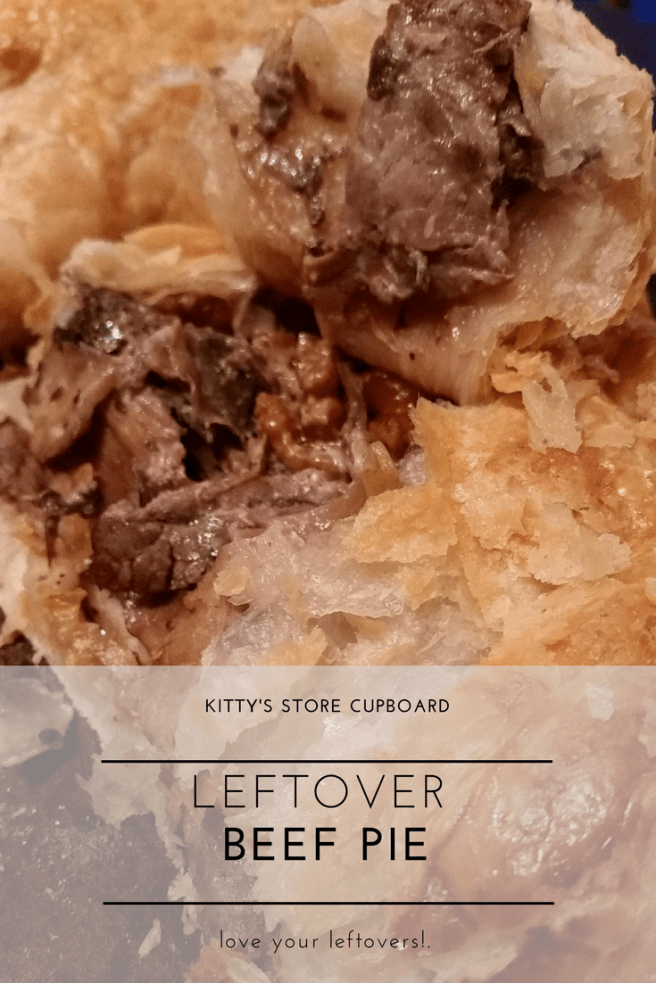
Leftover Beef Pie

This was a proper make-it-up job.It wasn’t something that I  would have thought of if I didn’t happen to have some cooked beef, mushrooms and cream in the fridge which needed  using up and puff pastry in the freezer.

beef pie

I went rifling through the cupboards for further inspiration and decided to add to the mix some walnuts, shallots from my mum’s garden, a little white wine, mustard powder, mace and black pepper. I had a sneaky suspicion that this would be a winning combination, what I didn’t expect is that the spice combination would strongly remind me of haggis – one of my favourite things. But for for the squeamish it is minus the offal!
It was so delicious! I will definitely make it again.

Filling

  • A couple of handfuls of cooked beef ripped into bite-size pieces
  • A couple of handfuls of finely chopped mushrooms
  • A couple of finely chopped shallots
  • A handful of walnuts, broken into pieces
  • A good splash of cream
  • A small splash of white  wine
  • Teaspoon mace
  • Teaspoon Mustard powder
  • Good grind of pepper
  • Salt

Method

Preheat the oven to 200oC.

Mix the above ingredients in a bowl.

Take the ready-roll pastry and cut it into two pieces. On each piece, pile up your beef mix on half of the pastry and then fold it in half, then turn the edges over and press down with a fork. Brush with beaten egg and grind some salt onto the top.

Bake in the centre of the oven for about 25 minutes, until golden brown.

beef pie

beef pie


Omelette.

I didn’t know that I could make omelette. In the Allcock family it is traditionally something that only my Dad makes, so when Emma requested it for her cooking lesson I have to admit that my heart sank a little. I wasn’t confident to make it up as I went along as I usually do so I dutifully scouted the internet for a recipe and came across one by Jamie Oliver – I reckoned that he probably knew what he was talking about so I went with using his basic recipe.

Emma and I added artichoke, bacon and olives to our omelettes which was delicious. The joy of this recipe is that you can add all sorts of things, and can do each one differently if you have picky people to cook for. It’s good for using up leftovers – I am quite tempted to make one with some leftover roast chicken tomorrow – and you can throw all sorts of store-cupboard bits at it to make it more interesting.

Omelette

Basic Ingredients
For one person

  • 2 large free-range eggs
  • salt
  • black pepper
  • 1 small knob butter
  • 1 small handful Cheddar cheese , grated

Method for a Basic omelette:

  1. Crack the eggs into a mixing bowl with a pinch of salt and pepper. Beat well with a fork.
  2. Put a small frying pan on a low heat and let it get hot. Add a small knob of butter. When the butter has melted and is bubbling, add your eggs and move the pan around to spread them out evenly. When the omelette begins to cook and firm up, but still has a little raw egg on top, sprinkle over the cheese.
  3. Using a spatula, ease around the edges of the omelette, then fold it over in half. When it starts to turn golden brown underneath, remove the pan from the heat and slide the omelette on to a plate.

Method using added yummy stuff:

Follow the recipe above; but prepare the extra bits (some may need cooking first) and then when you get to Stage 3 put them on top of the cheese before you fold it over.

Some examples of things you might like to add:

  • Mushrooms
  • Ham
  • Tuna
  • Sweetcorn
  • Spinach
  • Bacon
  • Onion
  • Cooked chicken
  • Courgette

Some of these will need grilling or frying first, such as the bacon, courgette and onion.

Please do share with me your omelette creations – I would love to know what weird, wonderful & delicious combinations you use!

wp-1469183382615.jpg

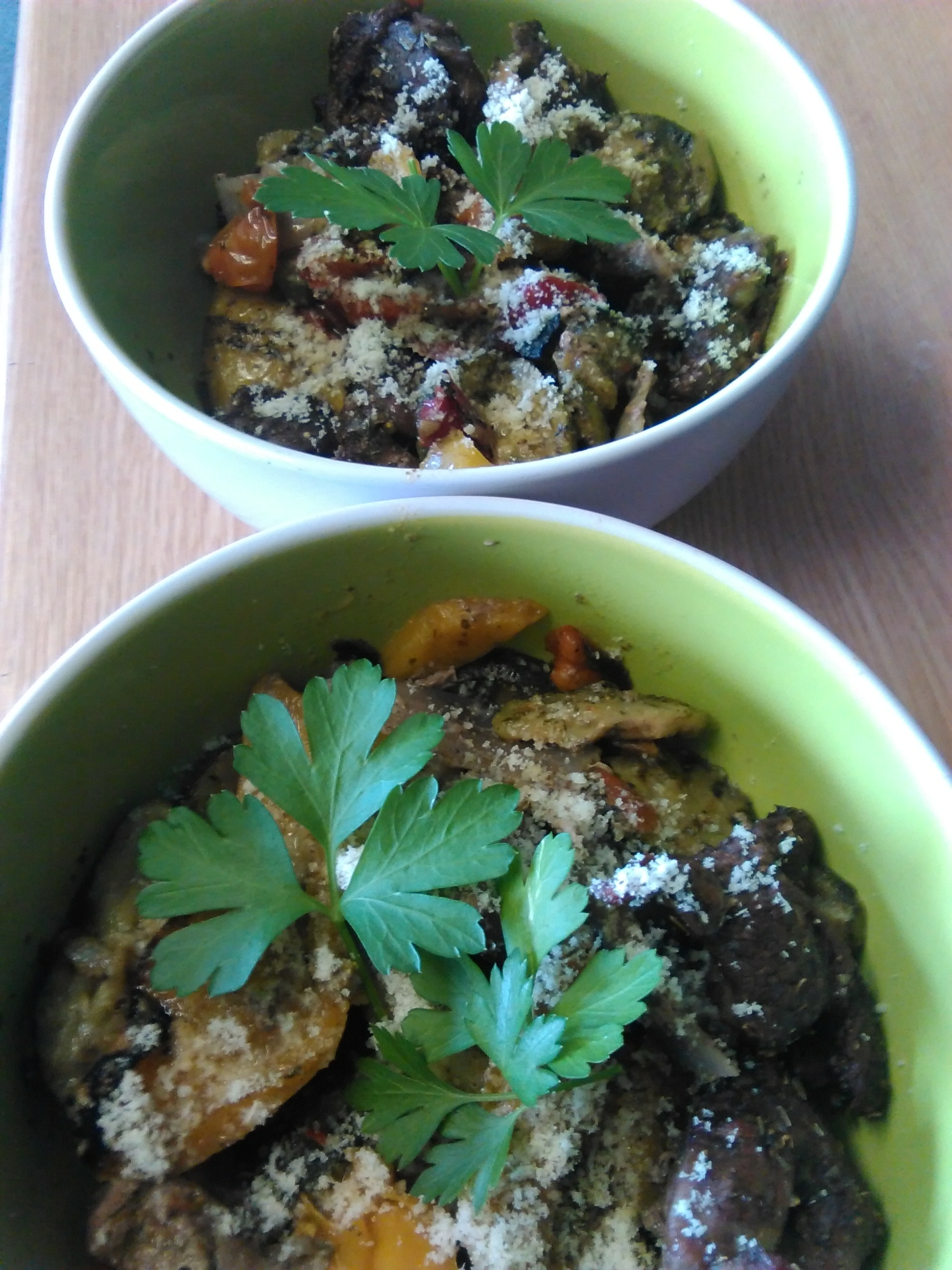
Michelle’s ‘fridge gravel’ supper with lamb

image

This recipe comes from a lovely lady who I met volunteering at Stroud District Foodbank. Michelle is a writer who is in love with her slow-cooker – a lady after my own heart!

Michelle and I bonded over conversations about frugal food and storecupboard cooking, and I have rather fallen for her phrase ‘fridge gravel’ which describes the ‘stuff’ that accumulates at the bottom of your fridge (unless you are a super-organised meal planner!). Here is a ‘fridge gravel’ meal which Michelle cooked last week, and kindly wrote up for me to share with you.

Ingredients
This dish comprised mainly from what was found lurking in the bottom of my fridge, the end of a bag of frozen vegetables, and some cheap diced fresh lamb that was marked down at the supermarket (300g for around £1.50 I think).

The vegetable mix consisted of:
1 small courgette, sliced
1 yellow pepper (that was crushed and discounted), sliced
1 red onion, peeled and quartered
1/2 red pepper, sliced (from the freezer)
About 4 cherry tomatoes, whole (leftovers from a larger tub)

Method
Throw all the prepared veg into a mixing bowl and pour over a generous glug of Olive oil. Sprinkle over some salt and ground black pepper and about a teaspoon of any dried herbs of your choosing that you may have hanging around in your kitchen cupboard.

For this dish I used dried Basil and Oregano, but I often change this according to whatever meat I am including with the dish. For example I have made similar mixes before using diced chicken pieces with Chinese five spice and a shake of soy sauce, or dried mixed herbs and parsley when using diced beef.

In a separate bowl mix the diced lamb with a little Olive oil, salt and ground black pepper, and again whatever herbs you fancy. I added a bit of dried tarragon to the meat to give it a slightly different flavour than the more Mediterranean style herbs used for the veg.

Line a baking tray with tin foil and spread out the vegetables evenly in one layer. Put the pieces of lamb on top of the veg – making sure to spread the meat out evenly and not letting it all clump together.

Bake for about 30 to 35 minutes at 200 Celsius or Gas mark 7 until all the vegetables are tender and the meat is cooked through.

Divide between two bowls and sprinkle over some grated Parmesan cheese (optional) and serve hot.

You can use whatever combination of vegetables you may find lurking in your fridge or freezer, even if they are looking a bit sad and old! I tend to do my ‘fridge gravel’ tray bake once or twice per month when cleaning out the fridge and using up any leftovers I find along the way.

Cheap, tasty and filling. Enjoy!

Chocolate and Almond Bread & Butter Pudding

image

Bread and Butter Pudding is a good old-fashioned frugal recipe, which uses up dry bread which would otherwise go to waste. The traditional recipe uses bread and butter, dried fruit, sugar, eggs and milk.

There are many little twists that can be made to this basic recipe; for this one I used Almond Milk instead of cows milk and mixed coco-powder in with the demerara sugar to make nice chocolatey layers.

Ingredients

  • Dry sliced bread (about 1/2 loaf)
  • Butter
  • 2 tablespoons demerara sugar
  • 2 tablespoons coco powder
  • 1 cup raisins
  • 2 or 3 eggs (I only had 2 which was fine, but 3 would have been better)
  • 1 pint almond milk
  • 1 tablespoon flaked almonds
  • 1 teaspoon nutmeg

Method

Pre-heat the oven to 180oC.

Mix the sugar and coco powder in a bowl.

Place a layer of buttered bread in the bottom of your dish, as closely fitting as possible. Cover with a layer of the chocolate mixture and a sprinkle of raisins.

Repeat until you have at least three bread layers.

In a jug measure out a pint of milk and beat the eggs into it.

Pour the mixture onto the bread layers; all but the top bread layer should be covered. Add more milk if necessary.

Sprinkle flaked almonds and some nutmeg on the top and bake in the centre of the oven for about half an hour.

image

Odds and Sods Soup

I have decided that it is time to go back to my £5 a week food budget – I have become lazy recently, and although I have maintained the discipline of not wasting food it has become too easy to spend more than I need to and to do ‘lazy cooking’.

I have not yet spent my £5 this week, and I did not top up my storecupboard before commencing my budget cooking – no cheating! Before I spend my £5 I need to use up some fresh ingredients; my lovely lodger is working away for a week and has left me with a fridge full of yummy things which I cannot let go to waste, so what I have to start with is:
– a couple of rashers of bacon
– a bag of green salad
– an avacado
– salami & parma ham
– red peppers

Thanks Amy!

I also have carrots which very much need using up, onions, garlic, a lonely potato, a lonely tomato, fresh bread, and of course my trusty spice cupboard.

image

So of course I started with soup.

Ingredients

– one onion
– one potato
– one big tomato
– one red pepper
– six carrots
– 2 cloves of garlic
– smokey paprika
– stock from the freezer (or a vegetable or chicken stock cube)
– salt and pepper to taste

Method
Finely chop all of the vegetables apart from the tomato. Fry in a large saucepan with the paprika and a little oil or butter.
Put the tomato in a bowl of boiling water straight from the kettle; when it has been in there a few minutes you will find that the skin peels off easily.
Add the tomato to the other vegetables along with a pint of stock – I used my turkey stock from the freezer, but you could equally use a vegetable stock cube.
Simmer until the vegetables feel soft when you put a fork in them – about 20 minutes – then blend using a food processor or hand blender.
Return the blended vegetables to the saucepan and continue to cook on a low heat, adding more liquid (water or milk) if you think that the consistency is too thick.
Taste, and season with salt and pepper if required.
Serve with toast and lots of butter.

… and I have plenty left for lunch tomorrow – hurrah!

Kitty’s Vegetable Curry #2

Another vegetable curry – this one Dahl-based. The previous one was pretty darn good if you want to check it out!

image

I have done many variations on this recipe over the years, very much depending on what vegetables I happen to have; also on whether I’m making it as a side-dish which I do quite mild, or a meal in itself which I like somewhat spicier. This time I used carrots, plus spinach and the crumbly cheese which I needed to use up and had also put in my pasta yesterday – very versatile!

Ingredients

  •  1 Onion
  • 2 Carrots
  • 1 clove Garlic
  • 1 teaspoon ground coriander
  • 1 teaspoon ground turmeric
  • 1/2 teaspoon ground Cinnamon
  • 1 teaspoon Cumin seeds
  • 1 teaspoon Mustard seeds
  • 1 dried chilli, chopped
  • 1 cup of Red Lentils
  • 1 pint of vegetable stock
  • A couple of handfuls of Spinach
  • Some chilli salt to taste
  • Approx 1/3 cup of crumbly cheese

Method

Fry the onion, garlic, carrots and spices in oil. When the onion is becoming transparent, add the lentils and stock.

Allow to simmer for about half an hour,  adding more water if it begins to dry out.

Taste, and add chilli salt as required.

Stir in the spinach. When the spinach has wilted serve with a generous sprinkle of crumbled cheese.

… and it was even better the next day with potatoes roasted in coconut butter with mustard seeds and black onion seeds :).

image

January Challenge ‘de-brief’

I am almost exactly a month into my life as a food blogger, and I have to say that this is definitely the most difficult post that I have written so far. Those of you who have been following me for the last month will know that I set myself a challenge at the beginning of January to ‘cook using only what I already have in my cupboards and freezer, plus what I can buy for £5 a week’;  you will also know that I like to communicate what I have been cooking with minimal ‘waffle’. Now that February has arrived it is time to reflect on my January Challenge and I really hope that I can do so in a concise and interesting way. Please leave me a message if you make it all the way to bottom!

Most importantly, I must say that I have really enjoyed giving myself a ridiculous budget for a month; it reminded me of how much fun it is to be creative with my cooking, and in addition it ‘reset’ my shopping habits and prevented me from producing any food waste.

What I would really like to get across to you is how well you can eat on a small weekly budget if you keep a few ‘core’ things in your storecupboard. If you are not used to this style of food shopping and cooking then there will be some upfront expenditure (but not much, see below how much I spent on topping-up my cupboards at the end of the month); but once you have initially stocked up there will just be a small ‘rolling cost’ as you replace things.

So here goes a short retrospective on my January Challenge:

What did I buy with my £5 a week?

My first £5 was spent on onions, carrots, mushrooms, some good British sausages, a lime & soda from my local pub, and some reduced bread for my freezer.

Lesson #1 – lime & soda is totally pointless and a waste of money!

During the second week I spent the princely sum of £4.88 on free range eggs, carrots, new potatoes, frozen peas and a British lamb shank.

Lesson #2 – a box of mixed-sized eggs is considerably cheaper than buying a box of identical eggs, and unless you are doing high-precision baking they are just as good.

For the last couple of weeks of the challenge I was more ‘bitty’ in my shopping (I didn’t have time for a ‘big’ £5 shopping trip!) and I was not quite so disciplined in writing up what I had bought; in summary I topped up the onions, potatoes, mushrooms and carrots, and I had a cup of tea at a church coffee morning for a whole 80p – decadent!
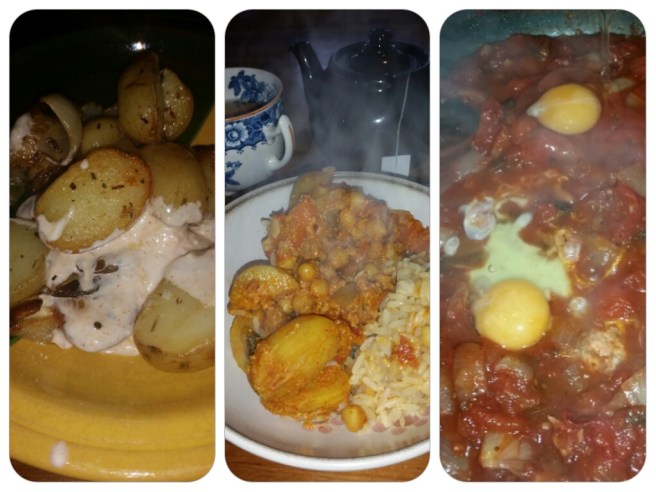
wp-1454531206143.jpeg

What are my new favourite recipes?

As I mentioned above, one of the best things about giving myself a ridiculous budget was re-discovering my creative ‘make-it-up-as-you-go-along’ cooking flair! I think that my favourite was probably the Roasties with Garlic & Coconut Dip – this was a very spur of the moment ‘snack’ using some coconut yoghurt that a friend had left in my fridge, I will certainly be making it again.

If I had to choose another top creation it would be a difficult choice between the vegetable curry and spaghetti with tomatoes and poached egg.

Lesson #3 – if you don’t allow yourself to ‘pop to the shops’ for additional ingredients you will discover new and exciting (or sometimes just ‘interesting’) recipes!

Please do let me know what your favourite recipe has been so far, and do do do give them a try and let me know how easy or otherwise they are to follow!

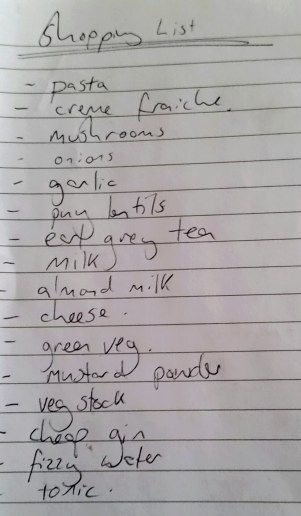
What did I run out of?

Early Grey tea – disaster! Tonic water – disaster! Garlic – disaster! Cheese, milk, almond milk, vegetable stock, pasta…
2016-02-01-20.11.28.jpg.jpeg

… and, as the observant amongst you will note, cheap gin! Don’t worry, I haven’t yet stooped to cheap gin; the reason I require it is to make Cranberry Gin… a recipe for another day. (Retrospectively, here is the Cranberry Gin recipe)

Despite making a show of being organised, I actually managed to forget the shopping list when I went for my ‘top-up shop’ – so in the end I forgot a few things, got a few extra things, and spent about £30 (including the gin). Not bad.

What is in Kitty’s Storecupboard?

Having set myself a ridiculous budget for a month I have concluded that the following constitute the ‘core’ storecupoard ingredients which I would be hard-pressed to do without (although I’m sure I’d cope!); I hope that I have demonstrated over the last month that very little is needed in addition to these things to cook some rather delicious meals.

‘Dry Goods’

  • Lentils (Puy and Red-split lentils)
  • Rice (brown and white)
  • Pasta
  • Couscous
  • Oats

Tins / jars / cartons

  • Tinned tomatoes
  • Tomato purée
  • Chickpeas
  • Butter beans
  • Pesto
  • Milk (‘cow’ or otherwise – I am rather fond of Almond Milk)

Baking ingredients

  • Plain flour
  • Self-raising flour
  • Margarine
  • Sugar
  • Golden syrup
  • Baking powder
  • Bicarbonate of Soda
  • A selection of nuts and dried fruit

Freezer

  • Peas
  • Stock
  • Cooked vegetables for soup (from when I got portion sizes wrong!)
  • a bit of meat and/or fish, usually from the reduced section of the supermarket

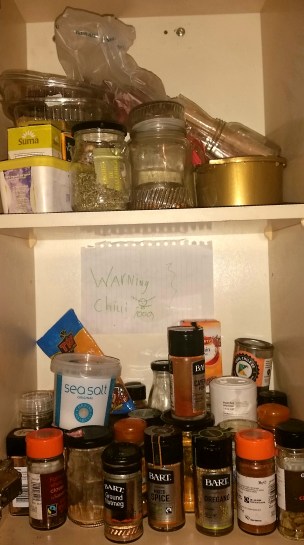
Spices
2016-02-03-20.47.59.jpg.jpeg

What can I say? A picture says a thousand words!

However, I would say that the ‘core’ herbs and spices for me are:

  • black pepper;
  • chilli flakes;
  • mustard seeds;
  • cumin seeds;
  • ground coriander;
  • mustard powder;
  • cayenne pepper; and
  • oregano, or some kind of mixed green herbs.

Garlic and onions are also very important!

and for my next challenge? I’ll keep you posted. In the mean time I have a number of January recipes to share with you which I ran out of time to write last month.

Well done for getting to the bottom of the page!

‘over and out!

Kitty

Kitty’s Soda Bread

wp-1451945135206.jpeg

It is over two weeks since I posted this taunting photograph with the Leftovers Soup, and I have finally got around to writing the promised (and much requested) recipe. Apologies for being a bit slack.
Ingredients

  • 125 g / 4 oz Bread Flour
  • 125 g / 4 oz Plain Flour
  • ½ Teaspoon Salt
  • ½ Teaspoon Bicarbonate of Soda
  • 15 g / ½ oz Butter
  • 225 – 250 ml / 7½ – 8 fl oz Plain Yoghurt
  • Beaten egg
  • Salt and pepper
  • Poppy seeds (optional)

I usually use ½ wholemeal flour (i.e. 4 oz Wholemeal Plain or 4 oz Wholemeal Bread Flour).

If you do not have plain yogurt, milk can be used instead but make sure that you start with a much smaller volume and work up to the correct texture.

wp-1454007211977.jpeg
Method

Pre-heat the oven to 200oC.

Sift the flours with the salt and bicarbonate of soda and then rub in the butter.

Add 225 ml / 7½ fl oz of the yoghurt all at once and mix quickly to make a soft dough, adding the additional yogurt only if necessary.

Shape into a 15 cm (6 inch) diameter ‘cake’ and place it onto a floured baking tray. Score deeply with the back of a knife into quarters.

Brush with beaten egg, then grind some salt and pepper onto the top. Seeds can be added at this point if you have them.

Bake in the centre of the oven for 30 minutes.

This soda bread is best served fresh from the oven. Enjoy with some nice butter, cheese and a lovely soup – such as this rather yummy one!

wp-1454007309820.jpeg

Spaghetti with tomatoes and poached eggs

image

Cheap, quick, easy and yummy – four of
my favourite things!
This fed two adults and a child (approximately 1/2 a tin of tomatoes per person and an egg each).

Ingredients:
1 Onion, chopped
1 Clove garlic, crushed
A few mushrooms, chopped
Black pepper
1 tsp Oregano
1 & 1/2 Tins tomatoes
A couple of squirts of tomato puree
3 eggs
A handful of grated cheese
Spaghetti

If I had them I might also have included bacon or anchovies, olives or capers.
image

Method:
Fry the onion, garlic, black pepper and herbs in olive oil until beginning to soften. Add the tinned tomatoes, tomato puree and mushrooms and simmer until the mushrooms have cooked.

While the sauce is simmering away put the spaghetti on to cook, following the instructions on the packet for the quantity and cooking time.

When the pasta is nearly done crack an egg into a mug, make a little well in the sauce and pour in the egg; repeat so that there is one egg per person. Note, if your pan is not non-stick you will probably need to put a bit of oil in each well before you add the egg.

After about a minute, turn each egg with a spatula and then sprinkle the cheese over the sauce.

Drain the pasta and divide between shallow bowls. Put an egg onto each serving of pasta and then share out the rest of the sauce.

Enjoy!

Kitty’s Vegetable Curry

This was rather good. I made it up on the spot but it was based on numerous other curries that I have made in the past.
As usual, there are things that you can add/ substitute if the contents of your fridge is a bit different from mine; I wouldn’t play around with the core spices too much though.
If you want this curry to be vegan then use coconut milk instead of the coconut yoghurt; the only reason that I had coconut yoghurt is that someone brought me a pot to go with a yummy pudding (thanks again Penny – I’m making it go a long way!). wp-1453118274768.jpeg

Ingredients:

These amounts would serve 2 to 3 people; I ate two portions last night (couldn’t resist seconds!) and then had the rest for brunch this morning.

  • 1 Onion, chopped
  • 1 or 2 cloves of Garlic, chopped
  • 1/2 teaspoon Cumin seeds
  • 1/2 teaspoon Ground cumin
  • 1 teaspoon Ground coriander
  • 1 teaspoon Turmeric
  • 1 teaspoon Chilli powder
  • 1 teaspoon Vegetable stock/ 1 vegetable stock-cube
  • 1 large carrot, chopped
  • 6 small new potatoes, halved
  • 1 large mushroom, chopped
  • 1/2 tin of chickpeas
  • 1/2 tin tomatoes
  • 3 tablespoons of coconut yoghurt
  • Rice (1/2 cup per person)
  • Cardamom pods (approx 1 per serving of rice)
  • a pinch of Saffron wp-1453116265020.jpeg

Method:
Fry the onion, carrot, potatoes, garlic and spices in a high smoke-point oil (groundnut or rapeseed/canola); you need to be reasonably generous with the oil and keep a good eye on it.

After a few minutes add the tinned tomatoes, the chickpeas and about 1/3 pint veg stock. When this is bubbling nicely turn it down to a low simmer and leave until the potatoes and carrots are cooked (about 15 minutes), stirring occasionally.

Next add the chopped mushroom and coconut yoghurt; at the same time put the rice on, I use 1/2 cup per person and add a little veg stock, cardamom pods and saffron if I have it. A good rule of thumb for cooking rice is for the ‘height’ of the rice in the pan and the ‘height’ of the water above the rice to be approximately the same; then, when the water is gone the rice should be cooked (I’m sure that some of  my Asian friends would contradict me there, but that’s how I do it).

When the the rice is cooked take it off the heat and taste the curry, seasoning with a bit more salt and chilli if required.

Serve.